
In industrial fleet operations, mining sites, and manufacturing plants across India, the dispensing of High-Speed Diesel (HSD) is a critical, high-volume activity. A fraction of a percentage lost to spillage, overfilling, or foaming can result in lakhs of rupees in annual operational losses. Furthermore, operating heavy-duty fuel transfer systems under the harsh realities of Indian site conditions—blistering ambient temperatures, heavy particulate dust, and fluctuating pump pressures—requires highly engineered dispensing equipment.
Choosing the right dispensing hardware is not merely a matter of connecting a pipe to a tank. It requires a precise understanding of fluid dynamics, pressure drop calculations, and shutoff mechanisms. For procurement heads and plant managers investing anywhere from ₹20,000 to ₹10,00,000 in fuel management systems, specifying the correct Fuel Nozzles is the ultimate safeguard against product loss, safety hazards, and operator fatigue. This guide provides a rigorous technical framework for selecting diesel nozzles that meet the stringent demands of Indian industrial applications.
1. What Are Fuel Nozzles and How Do They Function?
At their core, Fuel Nozzles are sophisticated, hand-operated flow control valves integrated with automatic safety mechanisms. Unlike basic manual ball valves, an industrial automatic shutoff nozzle operates on the principles of fluid dynamics, specifically the Venturi effect.
As diesel flows through the narrowest part of the nozzle body, its velocity increases, creating a localized pressure drop (vacuum). This vacuum is connected via a small sensing tube to the tip of the spout. As long as air can freely enter the sensing port at the spout tip, the internal diaphragm remains balanced, and the valve stays open. However, the moment rising fuel in the tank covers the sensing port, air is cut off. The vacuum rapidly builds up, overcoming the diaphragm spring tension, which instantly trips the holding latch and snaps the main valve shut.
This reliable, non-electrical automation prevents catastrophic overfills. For applications requiring precise volumetric tracking, Fuel Nozzles integrated with digital flow meters provide real-time dispensing data at the point of use.
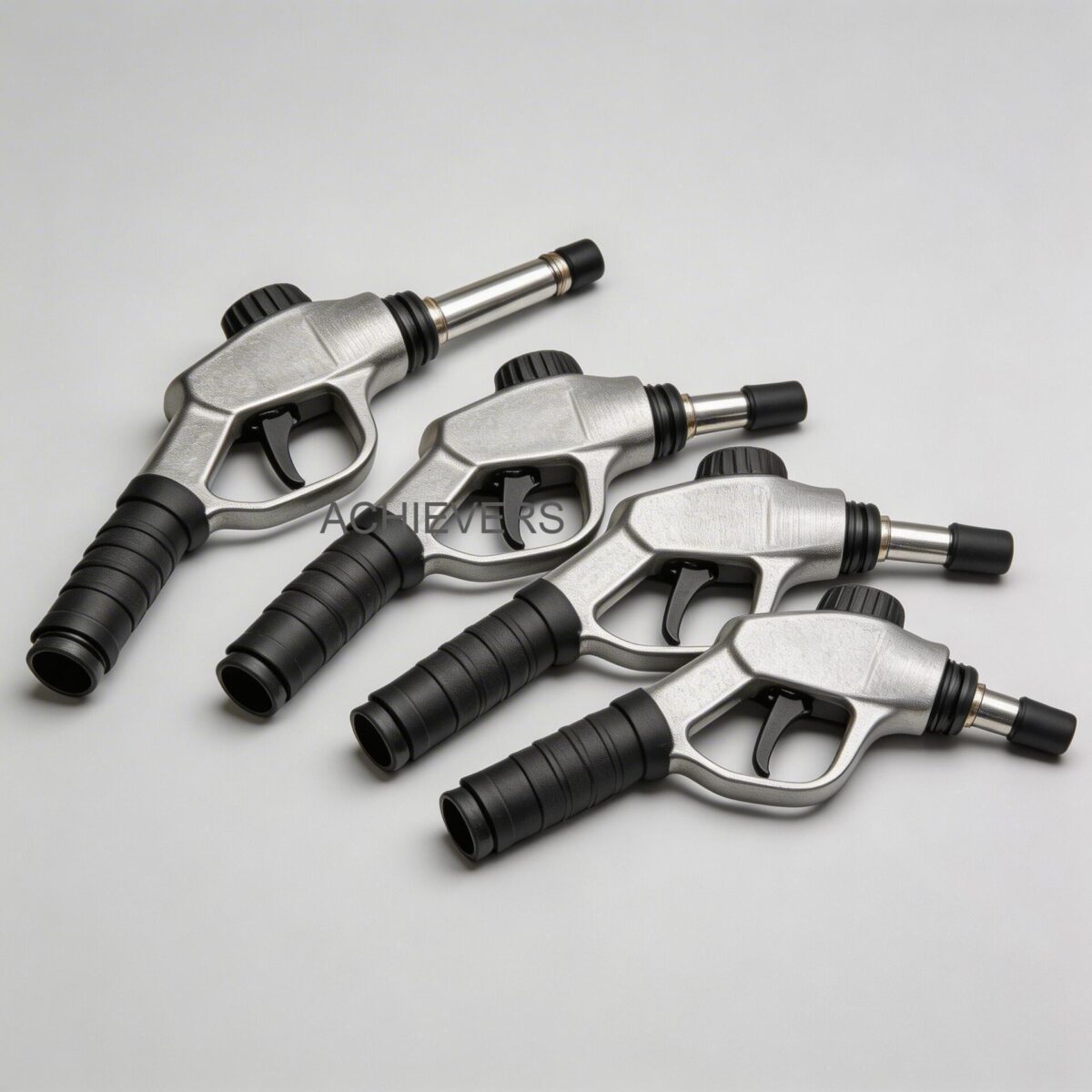
Core Product Specifications (Lumen Instruments "Achivers" Series)
Based on industry-standard engineering parameters, below are the specific technical specifications for the metering nozzles designed for diesel, gasoline, and motor oil:
| Specification Parameter | Value / Rating | Engineering Notes |
| :— | :— | :— |
| Inlet Thread Size | BSP 3/4" | British Standard Pipe parallel thread; ensures leak-proof mating with standard industrial dispensing hoses. |
| Spout Diameter | 13/16" | Optimized for standard diesel filler necks; reduces turbulent splashback. |
| Volumetric Flow Rate | 0 to 60 L/min | Ideal for light commercial vehicles, DG sets, and stationary plant equipment. |
| Maximum Operating Pressure | 0.18 MPa (approx. 26 PSI) | Suitable for standard transfer pumps. Exceeding this may cause premature shutoff or internal seal bypass. |
| Insulator Color | Red | Provides high visibility and UV resistance in outdoor dispensing bays. |
| Net Weight | 1.14 kgs / pc | Ergonomically balanced to reduce operator fatigue during continuous batching shifts. |
| Metering Display Types | Electronic & Mechanical | Dual-measurement capability for high accuracy and convenient data logging. |
2. Key Selection Criteria for Indian Industrial Buyers
When procuring nozzles for an industrial facility in India, engineers must evaluate several site-specific fluid and environmental parameters to prevent premature equipment failure.
A. Volumetric Flow Rate Compatibility
The nozzle must match the discharge rate of your Diesel Dispensers. If you push 80 L/min through a nozzle rated for 0-60 L/min, the excessive fluid velocity will generate severe turbulence and foaming. Diesel foam triggers the automatic shutoff sensor prematurely, forcing the operator to dispense manually at a trickle, destroying operational efficiency.
B. Automatic Shutoff Sensitivity
In dusty Indian environments like cement plants or open-cast coal mines, the vacuum sensing port on the spout can become partially occluded by particulate matter. You must select nozzles with robust Venturi designs that maintain high shutoff sensitivity even when dispensing moderately contaminated fuel. A delayed shutoff reaction time of even 1.5 seconds at 60 L/min results in a 1.5-liter hazardous spill over the equipment.
C. System Operating Pressure
The nozzle is a restriction in your piping network. The operating pressure of the "Achivers" metering nozzle is rated at 0.18 MPa (1.8 Bar). If your transfer pump delivers fluid at 4 Bar, the excessive dynamic pressure will force the internal poppet valve open or rupture the diaphragm. Always calculate the total dynamic head and pressure drop before specifying the nozzle.
D. Ergonomics and Continuous Duty Weight
A standard industrial diesel nozzle weighs approximately 1.14 kgs. For operators filling hundreds of fleet vehicles or drums daily, the trigger tension and the center of gravity of the nozzle are critical. A heavily front-weighted nozzle causes wrist strain, leading to improper seating in the filler neck and resulting in spills.
E. Material Compatibility and Construction
Indian diesel often suffers from adulteration and high moisture content during the monsoon season. Internal components must resist corrosion and degradation. The use of premium quality materials prevents the swelling of internal O-rings, which causes trigger jamming.
F. Measurement and Meter Integration
For decentralized fueling where bulk Diesel Flow Meters are not practical, utilizing a nozzle with an integrated digital flow meter provides masterful appearance, steady function, and dual-measurement visibility directly at the tank inlet. This is vital for accurate consumption logging per machine.
3. Technology Comparison Table & Decision Matrix
To achieve optimal fluid transfer, instrumentation engineers must select the correct variant based on the dispensing application. Below is a comparative analysis of the technologies available.
| Feature / Technology | Standard Manual Nozzle | Automatic Shutoff Nozzle | Digital Metering Nozzle |
| :— | :— | :— | :— |
| Primary Mechanism | Spring-loaded poppet valve | Venturi vacuum & diaphragm trip | Venturi shutoff + Turbine/Gear meter |
| Flow Rate Capability | Up to 150 L/min | 0 – 60 L/min (Standard models) | 0 – 60 L/min (High precision) |
| Overfill Protection | None (Visual monitoring only) | High (Sub-second reaction time) | High (Automatic trip) |
| Volumetric Accuracy | N/A | N/A (Relies on pump meter) | High accuracy (Dual-measurement) |
| Best Used For | Fast gravity-fed transfers | Fleet fueling, DG sets, heavy machinery | Custody transfer, remote asset logging |
| Weight Profile | Very Light (< 0.8 kg) | Medium (approx 1.0 kg) | Heaviest (approx 1.14 kg) |
"When to Use Which Technology" Decision Matrix
- Choose Standard Manual Nozzles if you are transferring highly viscous oils (motor oil) where the Venturi vacuum cannot reliably form, or if you are dispensing via a low-pressure gravity feed from an overhead tank where dynamic pressure is too low to actuate an automatic mechanism.
- Choose Automatic Shutoff Nozzles for standard diesel dispensing applications driven by AC/DC transfer pumps where safety, zero-spillage, and PESO (Petroleum and Explosives Safety Organisation) compliance are priorities.
- Choose Digital Metering Nozzles when dispensing expensive refined fuels into decentralized equipment (like remote DG sets or construction equipment) where you need high visibility of the exact volume dispensed to prevent internal pilferage.
Engineering Note: Flow Rate & Pressure Drop Calculation
When sizing your delivery hose and nozzle, instrumentation engineers must account for the pressure drop. The relationship between flow rate (Q), flow coefficient (Cv) of the nozzle, and the pressure differential (Delta P) across the nozzle is expressed as:
Q = Cv * sqrt(Delta P / SG)
Where:
- Q = Volumetric flow rate in Gallons per Minute (convert to L/min by multiplying by 3.785)
- Cv = The flow coefficient of the specific 3/4" nozzle
- Delta P = Pressure drop across the nozzle in PSI
- SG = Specific Gravity of the fluid (for High-Speed Diesel in India, typical SG is 0.83 at 15°C)
Always ensure your pump can overcome the calculated Delta P while maintaining the required flow rate of up to 60 L/min at a pressure not exceeding 0.18 MPa.
4. Common Mistakes Indian Buyers Make When Choosing
Procurement teams often treat nozzles as generic commodities. This leads to severe operational bottlenecks. Avoid these frequent engineering missteps:
- Mismatching Flow Rate with Pump Output: Installing a 0-60 L/min rated nozzle on a 100 L/min industrial transfer pump. The excessive velocity creates massive backpressure, causing the transfer pump to enter bypass mode, overheating the fuel, and causing continuous premature nozzle shutoffs.
- Ignoring Inlet Thread Standards: Indian industries use a mix of NPT (National Pipe Taper) and BSP (British Standard Pipe) threads. Forcing a BSP 3/4" nozzle onto an NPT hose fitting damages the threads, leading to high-pressure diesel leaks over the operator's hands. Always match the BSP 3/4" spec exactly.
- Using Diesel Nozzles for High-Viscosity Lubricants: While some metering nozzles support motor oil, automatic shutoff mechanisms rely on fluid velocity to create a vacuum. High-viscosity oils move too slowly at standard pressures to create the necessary Venturi vacuum, rendering the automatic shutoff useless.
- Neglecting Inline Filtration: Indian diesel storage tanks frequently accumulate rust, scale, and silica dust. Without a 10-micron or 30-micron inline particulate filter upstream, debris will bypass the pump and lodge in the nozzle's main poppet valve seat, causing the nozzle to leak even when the trigger is released.
- Overlooking Drop Survivability: Procurement often buys light-duty commercial nozzles for heavy industrial use. Operators invariably drop nozzles on concrete floors. If the internal trip mechanism or the digital metering housing is not built with heavy-duty premium quality materials, a single drop will shatter the mechanical display or permanently jam the latching pin.
- Ignoring Thermal Expansion in Hoses: In regions like Rajasthan or Gujarat, ambient temperatures can exceed 45°C. Diesel trapped in the hose expands, drastically increasing static pressure. If the nozzle does not have a properly rated pressure-relief check valve, this thermal expansion can burst the hose or blow out the nozzle seals.
5. Enquiry Specification Checklist
When generating a Purchase Order or Request for Quotation (RFQ) for industrial dispensing equipment, provide your supplier with exact engineering specifications. Use this 8-step checklist to ensure you receive the correct configuration:
- Fluid Type and Specific Gravity: Clearly state if the fluid is High-Speed Diesel, Bio-Diesel (B20/B100), Gasoline, or Motor Oil, as this dictates O-ring and diaphragm material compatibility.
- Required Flow Rate Range: Specify your target operational flow rate (e.g., 40 to 60 L/min).
- Maximum System Operating Pressure: Confirm the delivery pressure of your pump does not exceed the nozzle's rating (0.18 MPa).
- Inlet Connection Specification: Specify exactly "BSP 3/4 inch female inlet" to match your existing swivels and hoses.
- Spout Diameter: Specify the 13/16" spout size to ensure compatibility with your target vehicle or machine filler necks.
- Metering Requirement: State whether you require a mechanical tally, an electronic digital readout, or a standard non-metered automatic shutoff.
- Environmental Operating Range: Mention the site location to ensure the insulator color (Red) is UV stabilized and the digital display can withstand local ambient temperatures.
- Accessories Required: Always specify the inclusion of a 3/4" inline rotary swivel. A swivel prevents the heavy rubber dispensing hose from twisting, which is the primary cause of wrist fatigue and premature hose rupture.
FAQ
Q: Can I use a 0-60 L/min rated diesel nozzle for a high-volume 120 L/min transfer pump?
A: No. Pushing 120 L/min through a nozzle designed for 60 L/min will result in severe fluid turbulence, extreme pressure drop, and continuous premature tripping of the automatic shutoff sensor due to fuel foaming. You must upgrade to a high-flow 1" or 1.5" nozzle.
Q: Why does my automatic nozzle keep shutting off immediately when I pull the trigger?
A: This usually indicates that the fluid velocity is too high, causing foam to block the sensing port, or that the filler neck is too narrow, causing rapid splashback. It can also occur if the Venturi sensing tube inside the spout is blocked by particulate debris or rust.
Q: Are these nozzles certified by Legal Metrology for commercial retail sales in India?
A: The digital flow meter nozzles provide high precision and steady function suitable for internal industrial batching, fleet monitoring, and inventory control. However, for commercial retail dispensing (selling fuel to the public), the entire dispenser unit must carry specific Legal Metrology and PESO certifications.
Q: Can the digital meter on the nozzle be calibrated onsite?
A: Yes, high-quality metering nozzles with electronic or mechanical displays typically feature a calibration screw or digital calibration factor adjustment. This allows instrumentation engineers to perform volumetric catch-tests (e.g., using a certified 20-liter proving can) and adjust the meter for localized viscosity and temperature variations.
Q: What is the purpose of the 13/16" spout size?
A: The 13/16 inch (approximately 21mm) outer diameter is the international and Indian standard for unleaded and standard light-duty diesel filler necks. It ensures the nozzle fits securely into the vehicle without leaving excessive gaps that could allow debris in, while leaving enough room to vent displaced air out of the tank.
Q: How often should the internal components of the nozzle be serviced?
A: In harsh Indian industrial environments, visual inspections should be daily. Preventative maintenance, including checking the spout geometry, testing the shutoff response time, and inspecting the swivel O-rings for weeping, should be conducted every 6 months or 500,000 liters dispensed, whichever comes first.
Q: Can I bypass the automatic shutoff feature if it breaks?
A: Bypassing the automatic shutoff mechanism by wedging the trigger open or removing the internal trip pin is a severe safety violation under Indian industrial safety standards. It guarantees catastrophic overfills, leading to fire hazards and environmental contamination. The nozzle must be repaired or replaced immediately.
Ready to upgrade your plant's fuel management infrastructure with precision-engineered dispensing solutions? Contact Lumen Instruments today with your required flow rate, fluid type, and system operating pressure, and our engineering team will help you specify the exact heavy-duty dispensing nozzles required for your demanding site conditions.