
The selection of dispensing hardware at the terminus of a fluid transfer system is a critical engineering decision that dictates operational safety, flow control accuracy, and environmental compliance. Plant managers and instrumentation engineers often encounter operational bottlenecks or hazardous spill incidents simply because the incorrect dispensing mechanism was specified for the duty cycle. This guide provides a definitive automatic shutoff vs manual fuel nozzles comparison for diesel dispensing, stripping away marketing claims to evaluate these devices on pure engineering criteria: venturi sensitivity, pressure-drop behavior, and mechanical failure modes.
Understanding the internal fluid dynamics and actuation mechanisms of Fuel Nozzles is essential for standardizing safe transfer protocols. Whether you are refuelling a multi-megawatt backup generator at a data center or managing a high-volume mobile transfer unit at a remote mining facility, the nozzle dictates the final flow velocity, aeration levels, and ultimate metering accuracy. By analyzing these technologies head-to-head, industrial buyers can specify the most reliable equipment to reduce downtime and eliminate costly spillage risks.
1. Overview of Fuel Nozzles Family
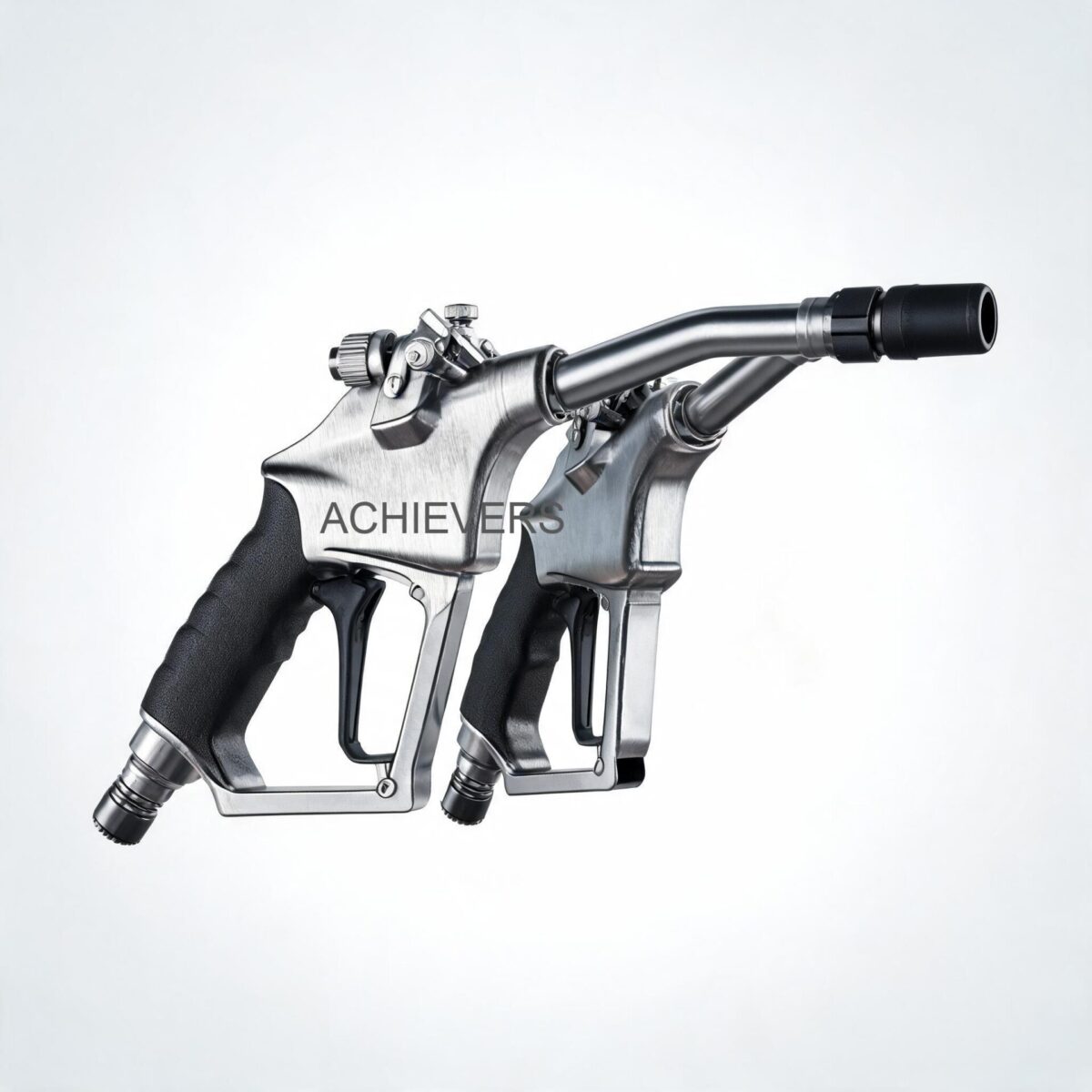
The fundamental purpose of industrial Fuel Nozzles is to provide controlled, directional fluid dispensing while minimizing flow restriction and preventing fluid surge. However, the internal architecture varies drastically between automatic and manual variants, dictating their suitability for different fluid types and operating pressures.
Manual nozzles operate via a direct-acting mechanical poppet valve. When the operator depresses the lever, the cam physically lifts the poppet against a return spring, allowing fluid to bypass the seat. This design offers a nearly straight-through flow path, resulting in an exceptionally low pressure drop (Delta P) across the valve body. It is highly robust, relying solely on operator intervention to halt the flow, which makes it ideal for high-viscosity fluids or gravity-fed systems where line pressure is minimal.
Automatic shutoff nozzles, conversely, are complex hydro-mechanical devices relying on the Venturi effect to autonomously halt fluid flow. The spout of an automatic nozzle contains a small sensing port connected to a vacuum tube that runs back to a diaphragm in the nozzle body. As fluid rushes through a venturi ring inside the nozzle, it creates a low-pressure zone.
Engineering Principle: Venturi Vacuum Generation
The actuation relies on Bernoulli's principle for incompressible fluids. The pressure drop created at the venturi throat is calculated as:
Differential Pressure = 0.5 * Fluid Density * ((Velocity at throat)^2 – (Velocity at inlet)^2)
As long as the sensing port at the tip of the spout remains exposed to air, air is drawn in, and the diaphragm remains in equilibrium. However, when the rising liquid level in the receiving tank submerges the spout tip, air can no longer enter the sensing port. The fluid flow continues to generate a vacuum, which abruptly pulls the internal diaphragm upward. This movement trips a mechanical latch pin holding the main valve stem, causing the heavy return spring to slam the main poppet shut in milliseconds, preventing an overflow.
Modern variants often integrate digital flow metering directly into the nozzle body. By incorporating miniaturized Turbine Flow Meters before the spout assembly, these intelligent nozzles provide real-time batch totals and cumulative volumetric data.
2. Head-to-Head Specification Comparison
To effectively specify industrial fuel nozzle specifications for manufacturers, engineers must cross-reference application limits against the nozzle's certified ratings. The following table contrasts a standard high-grade automatic shutoff nozzle against a heavy-duty manual equivalent based on actual baseline specifications for a 1-inch to 3/4-inch reducer application.
| Technical Specification / Feature | Automatic Shutoff Nozzle | Manual Nozzle |
| :— | :— | :— |
| Primary Shutoff Mechanism | Hydro-mechanical Venturi & Diaphragm | Direct Operator-Actuated Poppet |
| Inlet Thread Specification | BSP 3/4" (Standardized for metered lines) | BSP 3/4" or BSP 1" |
| Spout Outer Diameter | 13/16" (Unleaded/Diesel standard) | Variable (up to 1-1/4" for high flow) |
| Calibrated Flow Rate Range | 0 – 60 L/min | 0 – 80+ L/min (Limited by pump) |
| Maximum Operating Pressure | 0.18 MPa (1.8 Bar) | Up to 0.34 MPa (3.4 Bar) |
| Average Net Weight | 1.14 kgs/pc (Heavier due to latching internals) | 0.85 kgs/pc (Lighter, simpler casting) |
| Pressure Drop (Delta P) | Moderate to High (Venturi restriction) | Low (Straight flow path) |
| Insulator / Jacket Color | Red (Standardized visual coding) | Variable / Often unjacketed |
| Fluid Viscosity Limit | Low to Medium (Diesel, Kerosene, Petrol) | High (Heavy oils, lubricants, biofuels) |
| Minimum Operating Pressure | Requires minimum flow to generate vacuum | Zero minimum pressure (Gravity feed ok) |
| Primary Failure Mode | Blocked sensing port or torn diaphragm | O-ring wear or return spring fatigue |
| Operator Attendance Requirement | Minimal (Latch clip allows hands-free filling) | Constant (Dead-man switch principle) |
When selecting a Fuel Nozzles supplier, these specifications act as the baseline. The 0.18 MPa pressure limitation on the automatic variant is critical; exceeding this pressure can cause the internal poppet to flutter or fail to close against the fluid force, negating the safety mechanism.
3. Application Comparison Table
Different industrial environments impose distinct rheological and environmental challenges on dispensing equipment. The best fuel nozzle for high flow diesel transfer at a retail depot will fail catastrophically if applied to high-viscosity bunker fuel transfer at an offshore facility.
| Application Scenario | Recommended Option | Engineering Reasoning |
| :— | :— | :— |
| Standard Fleet Diesel Refueling | Automatic Shutoff | Allows operators to manage other tasks while dispensing; eliminates tank overflow and environmental contamination. |
| High Viscosity Lube Oil Dispensing | Manual Nozzle | Heavy oils cannot generate sufficient velocity to create the required venturi vacuum, rendering automatic shutoff mechanisms useless. |
| Gravity-Fed Storage Tanks | Manual Nozzle | Gravity systems often operate below the minimum pressure required (e.g., < 0.5 bar) to trip an automatic diaphragm. |
| Hazardous Area (ATEX Zones) | Automatic Shutoff | Reduces operator exposure time near open fuel necks; limits vapor displacement and static charge accumulation through controlled shutoff. |
| Mobile Fueling Carts | Automatic Shutoff | Prevents splashing and spillage in unstable environments where tank levels are difficult to monitor visually. |
| High-Volume Bulk Transfer (>100 L/min) | Manual Nozzle (High Flow) | Large internal bore provides lower flow restriction (higher Cv value), preventing cavitation at the pump head. |
| Abrasive or Contaminated Fluids | Manual Nozzle | Particulates will rapidly clog the 1mm sensing port in an automatic nozzle spout, causing continuous failure to shut off. |
| Winter/Extreme Cold Environments | Automatic Shutoff | Operators wearing heavy PPE lack tactile feedback for manual valves; automatic latching ensures safe, precise fills in freezing conditions. |
4. Total Cost Comparison
Procurement teams must evaluate dispensing hardware not just on initial capital expenditure, but on the total lifecycle cost, including maintenance intervals and expected service life under industrial duty cycles. The table below represents a global cost baseline (presented in INR equivalents for standardized comparative modeling).
| Nozzle Option | Purchase Range (INR Equivalent) | Annual Maintenance (INR) | Expected Life (Standard Duty) | Best For… |
| :— | :— | :— | :— | :— |
| Standard Manual Nozzle | ₹1,500 – ₹3,500 | ₹500 (O-ring replacement) | 3 – 5 Years | Gravity systems, viscous oils, harsh particulate environments. |
| Heavy-Duty Manual | ₹4,000 – ₹7,000 | ₹800 (Seal & spring kits) | 5 – 8 Years | High-volume bulk transfer, offshore, aggressive chemicals. |
| Standard Auto-Shutoff | ₹3,500 – ₹6,500 | ₹1,200 (Spout & diaphragm cleaning) | 2 – 4 Years | Fleet depots, commercial pumps, standard diesel dispensing. |
| Auto-Shutoff w/ Digital Meter | ₹8,500 – ₹15,000 | ₹2,000 (Calibration & battery) | 2 – 5 Years | Decentralized inventory tracking, mobile dispensing units. |
Note: Lifespans assume standard non-corrosive fluid use within the 0.18 MPa pressure rating and standard 0-60 L/min flow limits.
5. Decision Guide: Which One for Your Plant?
Standardizing your fluid transfer operations requires mapping the dispensing hardware to your specific plant conditions. Follow this 8-step decision matrix to ensure you specify the correct equipment.
- Assess the Fluid Viscosity:
- Calculate System Delivery Pressure:
- Determine the Required Flow Rate:
- Evaluate System Integration:
- Analyze the Operational Environment (Particulates):
- Consider Operator Ergonomics and Safety:
- Check Tank Neck Geometry:
- Review Calibration Requirements:
If your fluid exceeds 10 cSt (centistokes) at operating temperature (such as heavy gear oils or cold hydraulic fluid), you must default to a manual nozzle. The venturi vacuum cannot overcome the sluggish fluid dynamics of highly viscous media to trigger the shutoff.
Check the output pressure of your transfer pump. If it exceeds 0.18 MPa (approx. 26 psi), a standard automatic nozzle may suffer from hydraulic lock or fail to shut off. You will need a pressure-reducing valve or a specialized high-pressure manual nozzle.
For precision dispensing into small tanks or generators, a standard 0-60 L/min automatic nozzle with a 13/16" spout is optimal. If you are filling massive earth-moving equipment tanks and need 150+ L/min, the flow restriction of a standard automatic nozzle will bottleneck the system; specify a 1" or 1.5" manual high-flow nozzle instead.
If you utilize Mobile Diesel Dispensers that travel to various sites, integrating an automatic nozzle with an inline digital flow meter provides vital, on-the-spot batching accuracy and prevents overfills on uneven terrain.
In dusty mining environments or agricultural sectors where fuel polishing is poor, debris can easily clog the venturi sensing port at the tip of an automatic nozzle. If filtration cannot be guaranteed below 30 microns, a manual nozzle will offer far higher reliability.
For dispensing operations taking longer than 2-3 minutes, requiring an operator to manually depress a stiff lever causes ergonomic strain. Automatic nozzles with latch pins allow hands-free operation, allowing the operator to stand back from potential vapor zones.
The venturi shutoff mechanism requires the fluid level to abruptly cover the spout tip. If the receiving tank has a long, highly angled, or obstructed fill pipe that causes severe fluid splashing, the automatic nozzle may suffer from "premature shutoff" due to foam or splash covering the sensing port before the tank is full.
If the nozzle is intended for custody transfer or precise inventory logging, ensure the selected nozzle has laminar flow characteristics that do not disrupt the upstream flow meter. Manual nozzles generally produce less turbulence, but metered automatic nozzles are factory-calibrated to account for the internal venturi disturbance.
FAQ
Q: Why does my automatic shutoff nozzle keep clicking off before the tank is full?
A: Premature shutoff is typically caused by excessive dispensing velocity creating fluid turbulence and foam in the fill pipe. The foam blocks the venturi sensing port at the tip of the spout, tricking the diaphragm into triggering the shutoff. Reducing the flow rate or altering the angle of insertion usually resolves this.
Q: Can I use an automatic nozzle on a gravity-fed fuel tank?
A: Generally, no. Automatic nozzles require a minimum flow velocity to generate the necessary vacuum in the venturi tube to pull the internal diaphragm. Gravity-fed systems usually lack the pressure (head) to achieve this velocity, resulting in the nozzle failing to shut off when the tank is full.
Q: What does the 0.18 MPa pressure specification mean for my system?
A: This refers to the maximum operating pressure the internal valve components can safely withstand. Exceeding 0.18 Megapascals (roughly 26 PSI) can cause the main poppet valve to remain forced open against the return spring, rendering the automatic shutoff mechanism useless and risking a massive spill.
Q: How often should the digital meter on a metered dispensing nozzle be calibrated?
A: In standard industrial applications, calibration should be verified every 6 to 12 months using a certified volumetric proving can. Extreme temperature fluctuations or dispensing abrasive fluids may necessitate quarterly calibrations to maintain accuracy within a 1% margin.
Q: Why is the spout size (13/16") important when ordering?
A: Spout diameter dictates compatibility with vehicle or equipment fill necks. A 13/16" spout is the global standard for unleaded petrol and standard light-duty diesel equipment. Using an oversized spout will prevent insertion, while an undersized spout can cause blow-back and poor sealing.
Q: Are manual nozzles inherently less safe than automatic ones?
A: Not necessarily. Manual nozzles force the operator to remain engaged (the "dead-man" principle). While they lack overfill prevention, operator attendance ensures immediate reaction to leaks or hazards, making them highly reliable in applications where automatic sensing ports would clog.
Q: Can I dispense highly viscous engine oil through an automatic diesel nozzle?
A: No. High viscosity fluids (above 10 cSt) move too slowly and are too thick to properly actuate the vacuum sensing port and diaphragm mechanism. The nozzle will function as a manual valve but will fail to shut off automatically.
Ready to upgrade your plant's dispensing safety and accuracy? Contact our engineering team today with your required flow rate, fluid type, and operating pressure. We will help you specify the exact Fuel Nozzles configuration—whether high-flow manual or metered automatic—engineered to withstand your site's specific duty cycle and eliminate costly downtime.