
In the Indian mining and quarrying sector, diesel is not just a utility; it is the lifeblood of Heavy Earth Moving Machinery (HEMM). Operating excavators, dump trucks, and loaders in environments like the iron ore mines of Bellary or the coal fields of Dhanbad presents extreme fluid handling challenges. Typical generic dispensing equipment degrades rapidly under these conditions. The ubiquitous combination of suspended abrasive dust, ambient temperatures reaching 48°C, and operator fatigue inevitably leads to mechanical failures, premature seal wear, and catastrophic diesel spillage. For plant managers and procurement heads managing fleets that consume lakhs of liters of diesel monthly, specifying heavy-duty Fuel Nozzles is a critical engineering decision that directly impacts operational expenditure (OPEX) and safety compliance.
Generic dispensing solutions fail in these aggressive environments because their internal mechanisms—specifically the poppet valves and Venturi vacuum sensing ports—are not designed to withstand high particulate ingress or high-vibration handling. When a conventional nozzle is dropped on rocky terrain, the spout deforms or the trigger mechanism misaligns, leading to failure of the automatic shutoff. This results in dangerous tank overflows. To mitigate these risks, industrial engineers must specify industrial-grade Fuel Nozzles designed with superior volumetric efficiency, ruggedized insulator casings, and precise flow control mechanisms. Selecting the right Fuel Nozzles requires a deep understanding of fluid dynamics, site-specific pressure ratings, and integration with existing high-flow pump architecture.
1. Industry Overview: The Fluid Challenge
The industrial landscape of Indian mining and quarrying dictates unique requirements for diesel dispensing. Unlike standard retail petrol bunks, mining sites operate rough-terrain mobile service trucks and skid-mounted tanks to refuel equipment directly at the working face. The fluids handled—primarily high-speed diesel (HSD) and heavy motor oils—are subjected to extreme environmental stressors.
Dust is the primary adversary. Fine silica or coal dust clings to diesel residue on the spout, eventually migrating into the auto-shutoff sensing port. Once this port is blocked, the Venturi effect cannot generate the vacuum required to trip the release mechanism, resulting in tank overflow. In a mining context, spilling just 10 liters of diesel per shift due to a failed shutoff translates to an annual loss of over ₹3,00,000 per vehicle, not accounting for the environmental cleanup costs mandated by the Directorate General of Mines Safety (DGMS).
Furthermore, Indian industrial sites frequently suffer from power quality issues, leading to voltage fluctuations in dispensing pumps. This causes sudden pressure surges (water hammer effect) in the delivery hose. The dispensing nozzle must feature a pressure rating capable of absorbing these dynamic shock loads without rupturing internal O-rings. Accurate metering is equally critical; unaccounted fuel is a major source of revenue leakage, necessitating precise flow measurement integrated directly at the dispensing point.
2. Product Capabilities Matched to Industry Needs
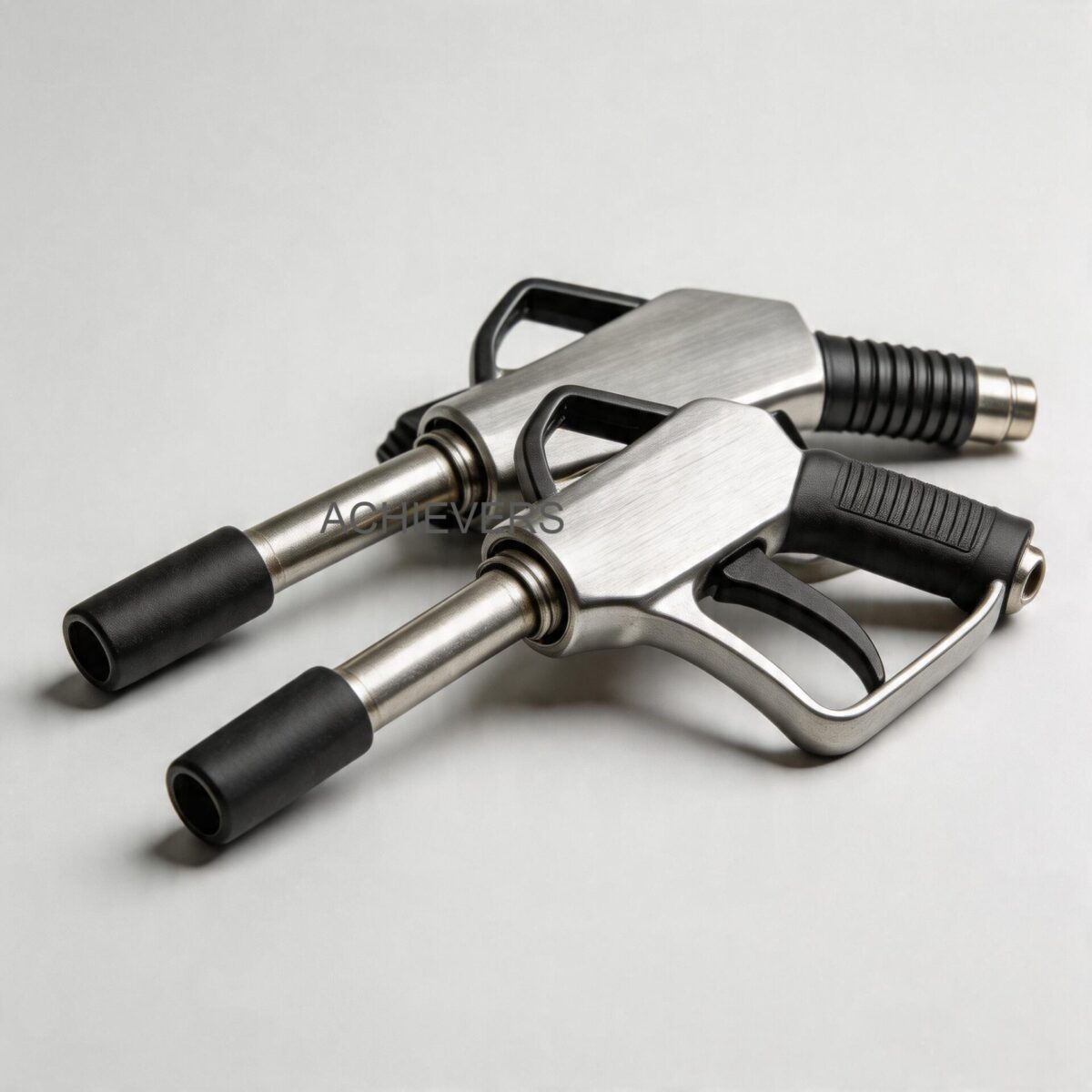
The Fuel Nozzles manufactured under the Achivers brand by Lumen Instruments (established in 2012 in Ahmedabad) are engineered specifically to combat these industrial realities. Built to exacting standards, these nozzles deliver stable performance with a flow rate of 0-60 L/min and a sustained pressure rating of 0.18 MPa (1.8 Bar).
Weighing exactly 1.14 kgs per piece, they strike the optimal balance between heavy-duty durability and operator ergonomics. The nozzle features an industry-standard Inlet Thread of BSP 3/4" and a Spout diameter of 13/16", ensuring seamless compatibility with standard Indian industrial hoses and HEMM fuel tank inlets. Available in automatic shutoff, manual, and digital flow meter configurations, these units provide precise dual-measurement capabilities for diesel, gasoline, and motor oil.
Industry Requirement vs. Product Capability
| Industry Requirement | Fuel Nozzles Feature | How It Addresses the Need |
| :— | :— | :— |
| High Particulate Dust Environment | Shielded sensing port and tight-tolerance assembly | Prevents dust ingress from clogging the Venturi vacuum mechanism, ensuring reliable auto-shutoff. |
| Rapid Refueling of HEMM | 0-60 L/min maximum flow rate | Matches the output of standard positive displacement pumps, minimizing machine downtime during refueling. |
| High Dynamic Hosing Pressures | 0.18 MPa (1.8 Bar) static pressure rating | Withstands backpressure and hydraulic shock from long hose reels on mobile lube vans. |
| Operator Fatigue Reduction | Optimized 1.14 kg net weight & ergonomic trigger | Reduces strain during continuous batch dispensing at end-of-shift refueling surges. |
| Rough Handling & Drop Risks | Heavy-duty construction with Red Insulator casing | Absorbs mechanical shock when dropped on rocky quarry surfaces, protecting internal valves. |
| Universal Equipment Compatibility | BSP 3/4" Inlet Thread | Allows leak-proof connection to standard Indian industrial fuel hoses without custom adapters. |
| Tight Tank Fill Necks | 13/16" Spout diameter | Fits perfectly into standard earthmover and transport truck fuel inlets, preventing splash-back. |
| Point-of-Dispense Accountability | Integrated Digital/Mechanical Flow Meter variants | Allows immediate, highly accurate measurement of dispensed fluid, preventing pilferage at remote sites. |
Technology Comparison Table: Nozzle Valve Mechanisms
When specifying a nozzle for an industrial plant, engineers must choose the correct underlying technology. While no single flow measurement site covers all parameters, comparing the mechanical action of these nozzles clarifies their industrial application.
| Parameter | Automatic Shutoff Nozzles | Digital Metered Nozzles | Manual Dispensing Nozzles |
| :— | :— | :— | :— |
| Mechanism | Venturi vacuum trip-valve | Turbine/Gear meter + manual valve | Direct mechanical poppet valve |
| Spillage Prevention | Exceptional (trips on fluid contact) | Moderate (relies on operator) | Poor (relies entirely on operator) |
| Flow Accuracy | N/A (Dispensing only) | High (±0.5% to ±1.0% typical) | N/A (Dispensing only) |
| Pressure Drop (ΔP) | Moderate (due to Venturi restriction) | High (due to internal metering chamber) | Low (unobstructed flow path) |
| Ideal Indian Use Case | Mining excavators, large DG sets | Remote custody transfer, lube oil batching | Gravity-fed temporary static tanks |
| Maintenance Need | Low (keep spout sensing port clean) | Medium (calibration of flow meter required) | Very Low (few moving parts) |

3. Typical Installation Scenarios in This Industry
Implementing these nozzles correctly requires understanding the system architecture. Below are three primary installation setups utilized in Indian heavy industries.
Scenario 1: Mobile Lube Vans and Service Trucks
In open-cast mines, taking excavators to a central fuel depot is highly inefficient. Instead, mobile service trucks navigate the quarry to refuel machinery.
- Setup: A diesel engine-driven or PTO-driven pump pushes fuel through a 15-meter retractable hose reel. The nozzle is subjected to severe vibrations during transit.
- Configuration: An automatic shutoff nozzle with a 3/4" BSP swivel joint is mandatory here. The swivel prevents hose kinking during unwinding.
- System Integration: Because the pump operates at variable RPMs, the nozzle's 0.18 MPa rating ensures that closed-valve backpressure does not rupture the internal seals before the pump's internal bypass valve actuates. (For highly integrated mobile solutions, engineers often pair these nozzles with Mobile Diesel Dispensers).
Scenario 2: Skid-Mounted Static Tanks for Quarry Depots
For haul trucks returning to the pit edge, temporary skid-mounted tanks are deployed.
- Setup: 20,000-liter horizontal tanks equipped with electric transfer pumps (often dealing with rural Indian voltage fluctuations from 180V to 250V).
- Configuration: Fuel Nozzles with integrated digital flow meters are ideal. Since these sites lack centralized digital management, the electronic or mechanical display on the nozzle provides a localized, tamper-evident record of the transaction.
- Key Settings: The metering nozzle must be calibrated for the specific kinematic viscosity of Indian HSD at ambient operating temperatures (which can lower viscosity significantly at 45°C).
Scenario 3: High-Flow Batching and Transfer Systems
In cement plants or construction sites, bulk fuel is transferred from main storage to secondary day tanks for power generation.
- Setup: High-capacity AC pumps transferring diesel over medium distances.
- Configuration: Standard automatic shutoff nozzles utilized as the terminal control valve.
- System Integration: These systems frequently utilize high-precision Diesel Flow Meters at the pump discharge, relying on the nozzle purely for fail-safe physical shutoff to prevent day-tank overflow.
4. Compliance, Accuracy, and Certification Requirements
Operating fuel dispensing equipment in India is heavily regulated. Procurement heads must ensure that their systems comply with the Legal Metrology Act (LMA) for custody transfer and the Petroleum and Explosives Safety Organization (PESO) guidelines for hazardous area operations.
Engineering & Calibration Note: The Auto-Shutoff Mechanism
The automatic shutoff mechanism is a marvel of applied fluid dynamics, relying entirely on Bernoulli's principle. Inside the nozzle, fuel flows past a Venturi ring, creating a low-pressure zone. A small sensing tube runs from this Venturi down to the tip of the spout.
As long as air is drawn through the spout tip, the pressure inside the nozzle's diaphragm chamber remains balanced. When fuel in the rising tank covers the tip of the spout, air is cut off. The Venturi instantly pulls a vacuum in the diaphragm chamber, which trips the mechanical latch holding the main poppet valve open. A heavy spring snaps the valve shut in milliseconds.
The physics governing the flow through the nozzle can be modeled using the orifice flow equation:
Q = Cd × A × √(2 × ΔP / ρ)
Where:
- Q = Volumetric flow rate (0-60 L/min for this model)
- Cd = Discharge coefficient of the nozzle's internal geometry
- A = Cross-sectional area of the 13/16" spout
- ΔP = Pressure drop across the nozzle
- ρ = Density of the fluid (approx. 832 kg/m³ for Indian diesel)
For instrumentation engineers, understanding this formula is critical when sizing the transfer pump. If the pump cannot overcome the pressure drop (ΔP) inherent to the nozzle's internal Venturi and metering chamber, the system will never achieve the rated 60 L/min flow rate, leading to extended refueling times.
Static Electricity and Safety Compliance
Indian site conditions, particularly during the dry summer months, create high risks for electrostatic discharge during high-flow dispensing. The robust metallic construction and the specific composition of the Red Insulator sleeve on Achivers nozzles ensure structural continuity. When paired with standard conductive hoses (IS 2309 compliance), static charge generated by fluid friction safely dissipates to the grounded pump skid, preventing spark ignition.
5. ROI and Operational Benefits
Investing in premium Fuel Nozzles rather than cheap, unbranded alternatives yields a massive Return on Investment (ROI) in industrial applications.
| Benefit | Typical Improvement | Indian Industry Context |
| :— | :— | :— |
| Fuel Loss Prevention | Reduces spillage by 95% | Eliminates overfills during shift-changes when operators are distracted. Saves approx. ₹2,50,000/year per dispensing point. |
| Equipment Uptime | 30% faster refueling cycles | Consistent 60 L/min flow allows a 500-liter dump truck tank to be filled in under 9 minutes, increasing operational hours. |
| Seal Longevity | 3x longer operational life | High-grade materials resist degradation from contaminated Indian diesel mixed with ethanol or adulterants. |
| Inventory Accuracy | ±0.5% batching variance | Metered nozzles ensure strict accountability for contractors buying fuel from the primary site depot. |
'When to Use This Technology' Decision Matrix
Use this matrix to determine the optimal nozzle configuration for your specific site conditions:
| Site Condition / Goal | Choose Automatic Shutoff | Choose Digital Metered | Choose Manual |
| :— | :— | :— | :— |
| Refueling large HEMM tanks (>300L) | Highly Recommended | Secondary | Not Recommended |
| Remote site dispensing accountability | Secondary | Highly Recommended | Not Recommended |
| Low-pressure, gravity-feed tanks | Not Recommended (vacuum won't trip) | Secondary | Highly Recommended |
| High dust / Heavy rain exposure | Highly Recommended | Requires protective cover | Secondary |
| Viscous oil/lubricant dispensing | Not Recommended | Highly Recommended | Secondary |
6. Selection Checklist for This Industry
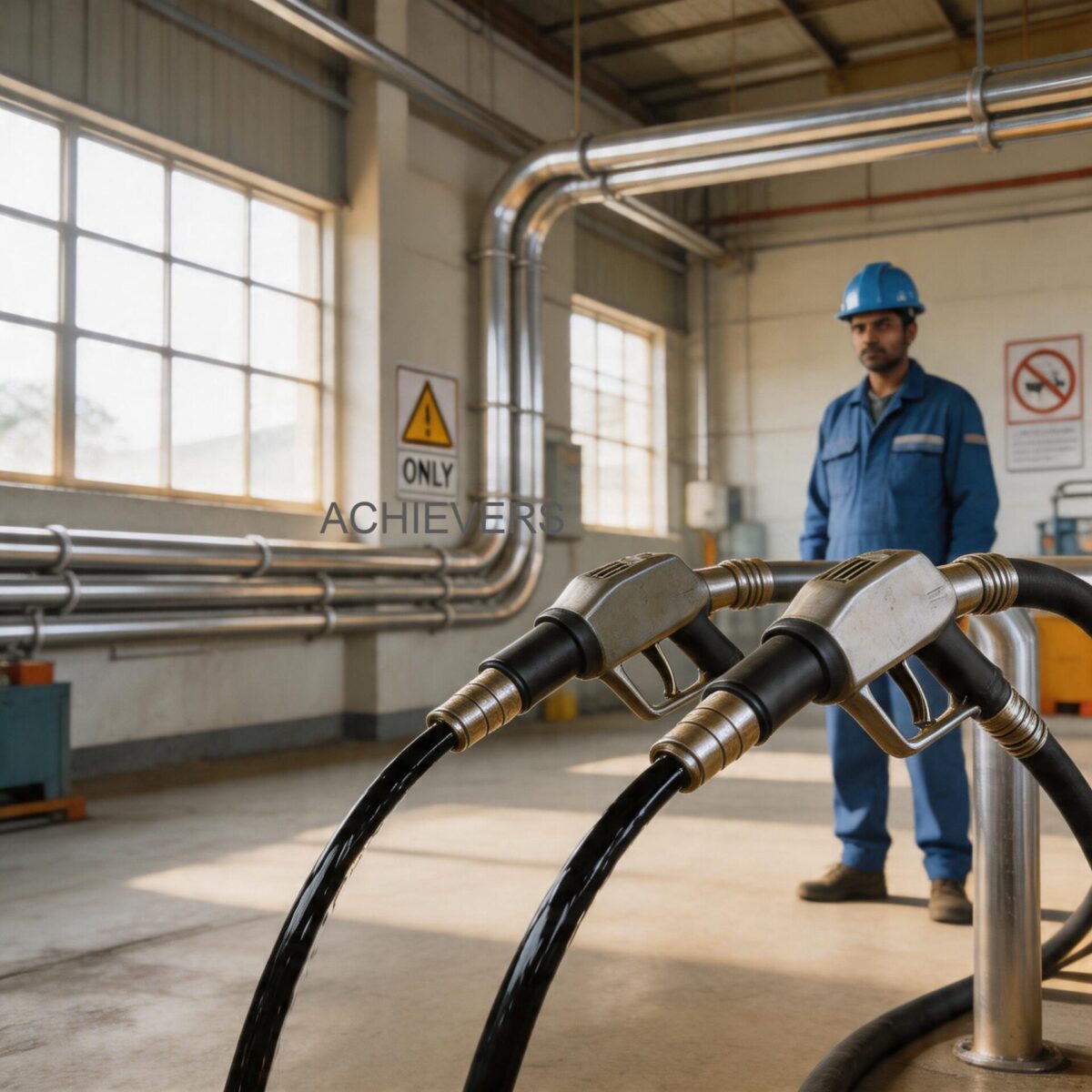
Before raising a purchase order for dispensing nozzles in a mining, construction, or heavy industrial application, engineering and procurement teams must verify the following eight specifications:
- Flow Rate Matching: Verify that the nozzle's rated capacity (0-60 L/min) matches the maximum discharge of your transfer pump. Using a 60 L/min nozzle on a 100 L/min pump will cause severe backpressure, pump cavitation, and hose failure.
- Thread Standard Compatibility: Ensure the inlet thread specifies BSP 3/4" (British Standard Pipe), which is the standard in India. NPT (National Pipe Thread) nozzles will leak if forced onto BSP hoses.
- Operating Pressure Rating: Confirm the continuous pressure rating meets or exceeds your system's dynamic pressure. The 0.18 MPa (1.8 Bar) rating is ideal for standard mobile and skid-mounted transfer pumps.
- Spout Diameter Clearance: The 13/16" spout must physically fit inside the fill neck of your machinery. Oversized spouts will not enter the tank, defeating the auto-shutoff mechanism.
- Swivel Joint Necessity: Always specify a swivel joint adapter for the BSP 3/4" inlet. Operating a rigid nozzle on a heavy 1-inch rubber hose causes operator wrist strain and premature hose cracking at the crimp.
- Sensing Port Positioning: Inspect the Venturi sensing port on the spout tip. For dusty Indian mines, ensure it is recessed or positioned to avoid direct packing with wet mud when dropped.
- Fluid Compatibility Check: Confirm the internal seals (O-rings and diaphragms) are rated for your specific fluid (Diesel, Gasoline, or Motor Oil).
- Weight and Ergonomics: For continuous fleet refueling, specify lightweight units. At 1.14 kgs, this nozzle minimizes operator fatigue during continuous batching processes.
FAQ
Q: Why does the automatic shutoff mechanism keep failing on my mining site?
A: In dusty environments, dirt mixes with diesel to form a paste that clogs the small vacuum sensing port at the tip of the spout. If air cannot flow through this port, the Venturi vacuum cannot build up to trip the release latch. Regular cleaning of the spout tip is mandatory.
Q: Can I use these Fuel Nozzles on a gravity-fed overhead tank?
A: Generally, automatic shutoff nozzles are not recommended for pure gravity-fed systems unless there is significant head pressure. The auto-shutoff mechanism requires a minimum flow velocity to create the Venturi vacuum. For low-pressure gravity tanks, manual nozzles are preferred.
Q: Is the BSP 3/4" inlet standard across all Indian industrial sites?
A: Yes, British Standard Pipe (BSP) thread is the standard for fluid power and transfer applications in India. You can connect these directly to standard fuel dispensing hoses without the need for specialized thread adapters.
Q: How frequently should the digital flow meter variant be calibrated?
A: In Indian industrial conditions with high ambient temperature fluctuations, we recommend verifying the calibration of digital metering nozzles every 6 months using a certified volumetric proving can. Wear from abrasive particles in poorly filtered diesel can alter the internal turbine or gear tolerances.
Q: What happens if the pump pressure exceeds the nozzle's 0.18 MPa rating?
A: If the static pressure exceeds 1.8 Bar (0.18 MPa)—typically caused by a positive displacement pump running against a closed nozzle without a functional bypass valve—the internal diaphragm or O-rings inside the nozzle may rupture, leading to external leaks.
Q: Are these nozzles suitable for dispensing high-viscosity motor oils?
A: While the digital metering variants are rated for motor oil, the automatic shutoff variants are optimized for the kinematic viscosity of diesel and gasoline. Highly viscous cold oils may not generate the proper flow velocity required to actuate the Venturi shutoff reliably.
Q: How does the 1.14 kg weight compare to standard commercial nozzles?
A: At 1.14 kgs, these are considered heavy-duty industrial units. They are slightly heavier than standard plastic retail petrol nozzles because they feature rugged metallic bodies and reinforced insulators designed to survive drops on concrete or rocky quarry floors.
To ensure your fleet operations remain safe, compliant, and free from costly diesel spillage, upgrading your dispensing points is a high-ROI priority. Contact our engineering team today with your specific pump flow rates, fluid types, and site conditions, and we will configure the exact nozzle variant required to optimize your high-flow refueling architecture.